Operation Napoleon Files
Operation NapoleonThe Operation Napoleon Files are a fragmentary cache of German documents recovered from the ice beside a dead officer, their significance suggested by a surviving typewritten phrase but never fully established in the available evidence. The papers turn the wreck’s unexplained mixture of German and American dead into a question of concealed history; their damaged, incomplete state also ensures that naming the secret is not the same as knowing it.
Discovery and recovery
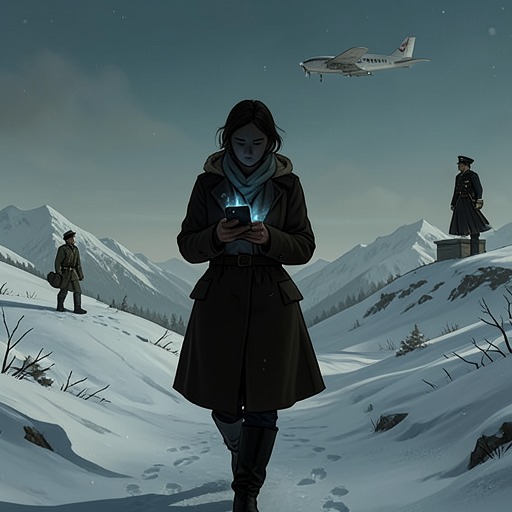
The files enter the story through a metal case found beside a German officer’s body. During work to dismantle the plane on Vatnajökull, Ratoff’s men uncover a corpse beside the fuselage: a man in a high-ranking German uniform, wearing an Iron Cross, with a cap frozen over his face. Ratoff judges that the body appears to have been deliberately laid there, and reasons that some passengers must have survived the crash long enough to tend to those who died. The discovery establishes the human setting in which the case and papers later acquire meaning: the wreck is not merely an abandoned aircraft, but a site where bodies may have been moved and where the sequence of events remains uncertain.
The connection between the documents and the wreck becomes more concrete when Jón explains that he took a box half-buried beside the German. He remembers it as if it had been handcuffed to the man, who must have carried it down from the glacier. The case he produces is scratched and dented, about the size of a small briefcase, with a handle and a lock that has plainly been tampered with; rust has eaten through parts of the metal. Its battered exterior records exposure and handling, but does not explain who opened it or when. Jón says he found papers inside and has removed nothing.
The case resonates with Ratoff’s earlier inspection of the wreck’s forward section, where he finds a dead American two-star general with a heavy-locked aluminum briefcase handcuffed to his left wrist. These details associate the mystery of the documents with the plane’s startling mixture of national uniforms and the presence of a secured case. The later discovery beside the German officer, however, is described as a rusty metal box, and the account does not establish precisely how the case moved or who handled it. Its uncertain provenance is part of the evidence, not a gap that can safely be filled in.
What the papers reveal—and what they do not
When Jón opens the case, its contents are already badly damaged. Years of alternating heat and cold have left the sheets so fragile that attempts to separate them make them fall apart. The documents are typewritten in German, but most individual letters have blurred into illegibility. Only an occasional word survives on the more intact pieces, including the phrase “Operation Napoleon.” Kristín inspects the outside for markings and then studies the papers themselves; the name is a legible remnant, not a readable account of the operation.
Jón cannot interpret the German. He infers importance from the circumstances instead: the man had apparently carried the case on his wrist across the glacier in the middle of a storm. Kristín asks what the phrase means, but the scene supplies no decipherment, description of the operation’s contents, or confirmation of the documents’ purpose. The papers therefore offer a specific clue while withholding the answer that clue seems to promise. Their physical deterioration makes the limitation visible: the historical record is present, but much of it cannot be recovered from what remains.
That distinction matters when the wreck’s other secrets are considered. Ratoff finds the general’s handcuffed briefcase among bodies preserved by the ice, and later counts six corpses in and beside the plane, although his briefing had indicated seven. In the tail section he also discovers an American pilot in a German aircraft, deepening the puzzle of who was aboard and why. These findings make the case part of a larger pattern of concealed or unexplained facts, but they do not prove that the papers themselves explain every anomaly. Kristín’s later assertions about what the plane is hiding exceed what the surviving documents, as presented, can verify.
Kristín’s use of the name
The phrase becomes consequential when Kristín confronts Ratoff at the glacier camp. After finding a body under a tarpaulin in a tent, she calls after him and says she knows about Napoleon. She specifies the Napoleon documents and “Operation Napoleon,” then claims to know what the Germans were doing and what the plane is hiding. Her account at that moment is not a demonstrated reading of the papers: she is feeling her way, driven by anger, and the narrative makes clear that her mind is blank beneath Ratoff’s stare.
Kristín describes the secret as papers rather than a bomb, gold, or virus, but this is her gambit, not independent confirmation of the files’ contents. Ratoff asks who else knows about Napoleon and presses her to say what she knows. His response signals that the name has touched a sensitive point, while his questions expose the weakness in Kristín’s position: she has a potent clue but no secure explanation to support her claim. The documents thus function both as evidence and as leverage, with their uncertain meaning making the confrontation dangerous rather than conclusive.
Significance and limits
The Operation Napoleon Files connect a damaged object to the novel’s central problem of how hidden history is recovered, controlled, and interpreted. The case’s lock, handcuff association, and battered metal shell suggest that the papers were treated as something to secure; their ruined pages show how little such security can guarantee against time and the glacier. The surviving phrase restores a name to what would otherwise be almost unreadable material, but it cannot restore the lost text around it.
The files’ narrative force lies in this tension between revelation and opacity. They make it possible for Kristín to identify the secret by name and to challenge Ratoff, yet leave the reader without a complete account of the operation from the documents themselves. Their recovery changes the question from whether the wreck conceals something to what the name on its ruined papers means—and who is prepared to act to keep that meaning from being known.